| Patient Registry |
| |
|
| |
A crucial objective of EuroPa is the
establishment of a central registry of clinically well described
patients, combined with a web-based entry system. This registry
will give EuroPa an advantage in planning and conducting multi-centre
clinical trials and research projects. Recruiting patients that
both fulfil diagnostic criteria and who are interested in participating
in trials can be time consuming. A regularly updated central data
base will be beneficial in accelerating the patient recruitment
process. In the long term, research results will be gained in a
shorter period of time and new therapies will be available earlier.
Participation in the EuroPa registry is voluntary and each patient
signs a consent form prior to data entry. At present, only patients
at the participating clinical centres will be included into the
registry. A uniform questionnaire – the minimal data set –
will be used to gather comparable clinical data from all patients.
Clinical data of all patients are stored pseudonymised. Only the
responsible staff at the treating clinical centre is able to re-identify
a certain patient. Re-identification will be necessary for follow-up
visits in order to update the clinical data and to inform patients
about any planned study or trial.
Technical
implementation
Access to the patient registry is password-protected and reserved
to authorised staff only. Each participating clinical centre can
only access its own data. Clinical data is be stored anonymised,
that is, patient personal data (name, date of birth, address) is
not stored in the central database. As it is illustrated in the
figure below, a pseudonym (Patient Identification Code - PID) will
be allocated randomly to each patient in order to reference the
medical data in the central database. A document mapping the PID
and the respective personal data has to be printed and stored safely
by the responsible physician in compliance with local data protection
regulations. |
| |
|
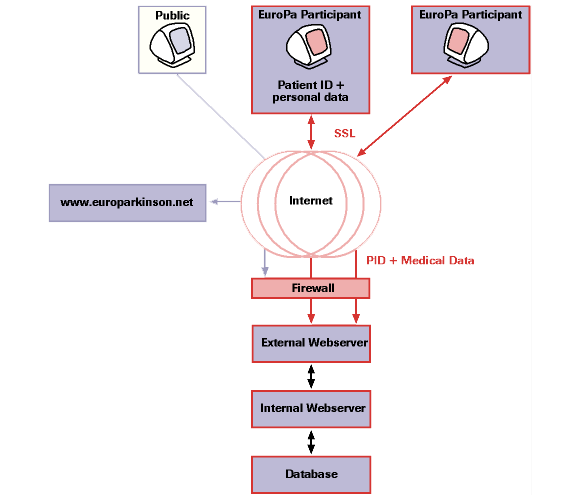 |
| Schematic view on IT infrastructure
of the EuroPa patient registry |
| |
Besides a regular web browser, no additional
software is required at the site of the user. EuroPa participants
who are authorised will access the external web server in order
to send information to the central database. Information is exchanged
by means of a web application, providing the questionnaire and various
options for data entry. The external web server is then requesting
the required information from the database and passing information
back to the EuroPa participant. Data transfer will be encrypted.
The database on the central server is only communicating with the
internal web server. The patient registry is further protected against
misuse by various security measures.
The EuroPa IT-infrastructure is being developed by the
interActive Systems GmbH, Berlin (Germany). |
| |
| |
|
|
