Parkinson’s disease (PD)
mainly affects the elderly. The number of patients is continually
growing due to the ageing of the population. Considering the rising
expenses for the health-care, it is therefore likely that health
economic research will increasingly provide a decision-making
framework. In the context of Parkinson's disease, decision-makers
in Europe have little current information on optimal strategies
for allocating resources in this area. Only a few studies for
PD have been presented (Bain et al. 2000, Chrischilles et al.
1998, Dodel et al. 1998, Haycock et al. 1995, Hoerger et al. 1998,
LePen et al. 1999, Rubenstein et al. 1997, Whettens-Goldstein
et al. 1997). Some data on expenses for Parkinson’s disease
in one year are available for some countries:
- USA: $ 14.3 billion (Whetten-Goldstein et al. 1997)
- Germany: $ 1.0 billion (Dodel et al. 1998)
- France: $ 411 million (LePen et al. 1999)
- UK: $ 280 million (Haycock et al. 1995)
- Sweden: $ 136 million (Hagell et al. 2002)
The lack of significant studies is in contrast to other neurological
diseases, such as Alzheimer's disease and epilepsy where detailed
economic data are available. As a part of EuroPa, the health economics
project will be one of the first health care utilization studies
of Parkinson's disease on an European level.
The project is divided into 3 steps:
- Descriptive analysis of how care of PD is organised in Europe
- Comparative analysis of burden-of-disease, health-related
quality of life and patient preferences (utilities) of PD in
Europe
- Establishment of a review board for health research of PD
patients in Europe
Step 1: Descriptive analysis of how care of PD is
organised in Europe
The aim of the first analysis is to highlight the different European
health system structures involved in the care of PD in most of
the participating countries: Austria, Czech Republic, France,
Germany, Italy, The Netherlands, Portugal, Spain, Sweden, United
Kingdom.
Getting an overview of the existing decision making processes
is important to understand the consequences of these processes
on the care of PD patients as basis for interpretation of health-economic
data from a national as well as an European perspective.
Methods:
A structured database search was conducted. Search parameters
were identified as keywords, which correspond to the information
requirements defined. Grey literature was hand searched and the
reference lists of identified studies and reviews examined. Additionally
research via telephone and Internet has been conducted. National
institutes for statistics, third party payers, national medical
societies, PD specialists, ministries of health, various national
and international organisations and support groups were contacted
for information on national care of PD.
Reviewed data: Definition of PD, epidemiology, national treatment
guidelines and treatment patterns, in-patient days, rehabilitation,
institutionalisation, home care, disease management programs and
availability of support groups.
Results:
Detailed information on PD care is not easily accessible in Europe,
despite the importance of the disease. Epidemiological data are
available for most of the investigated countries, except for the
Czech Republic and Austria. The studies differ considerably regarding
study design and criteria of diagnosis for PD which is commonly
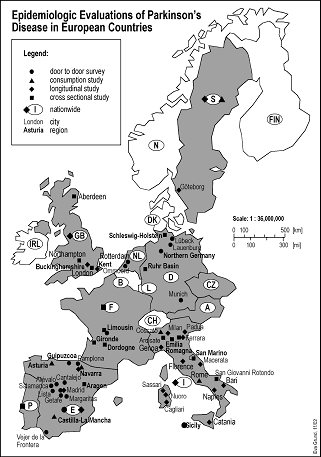
reported as reason for differences in prevalence. The graphic
gives an overview of epidemiological studies in the investigated
countries.
|